The Geographic and Historical Wonder of Ball’s Falls
In the heart of the Niagara region, nestled within the verdant embrace of the Twenty Valley, lies a remarkable geographic location where time seems to flow as powerfully as the waters of Twenty Mile Creek. This is the historic and geographic area of Ball’s Falls, a natural sanctuary and the site of a 19th-century ghost town.
Here, the ancient rock of the scenic Niagara Escarpment, a UNESCO World Biosphere Reserve, gives way to the thunderous plunge of two majestic waterfalls. Their mist feeds a lush Carolinian forest teeming with biodiversity. As you study this area, you are embarking on a journey through deep geological time and the pioneering history of Ontario. This independent enthusiast guide is dedicated to exploring the delicate balance between human heritage and ecological endurance in the Twenty Valley.
Geographical Coordinates and Topography
Situated in Lincoln, Ontario, this distinct geographic feature is an integral part of the Niagara Peninsula’s natural landscape. It is easily identifiable on geographic maps by the deep gorge carved by Twenty Mile Creek. The area is surrounded by the picturesque Twenty Valley, a topographical depression that channels the creek towards Lake Ontario. The rugged, natural terrain of the Niagara Escarpment defines the physical boundaries of this historical location, making it a subject of immense interest for geologists, historians, and nature lovers alike.
Geology: Two Spectacular Waterfalls on Twenty Mile Creek
The term “Ball’s Falls” describes the raw power and serene beauty of moving water over ancient rock formations. The area features two distinct and spectacular waterfalls, carved over millennia by the relentless flow of Twenty Mile Creek. These natural wonders are the geological anchors around which the area’s entire history has been shaped.
The Majestic Upper Falls: A Geological Plunge
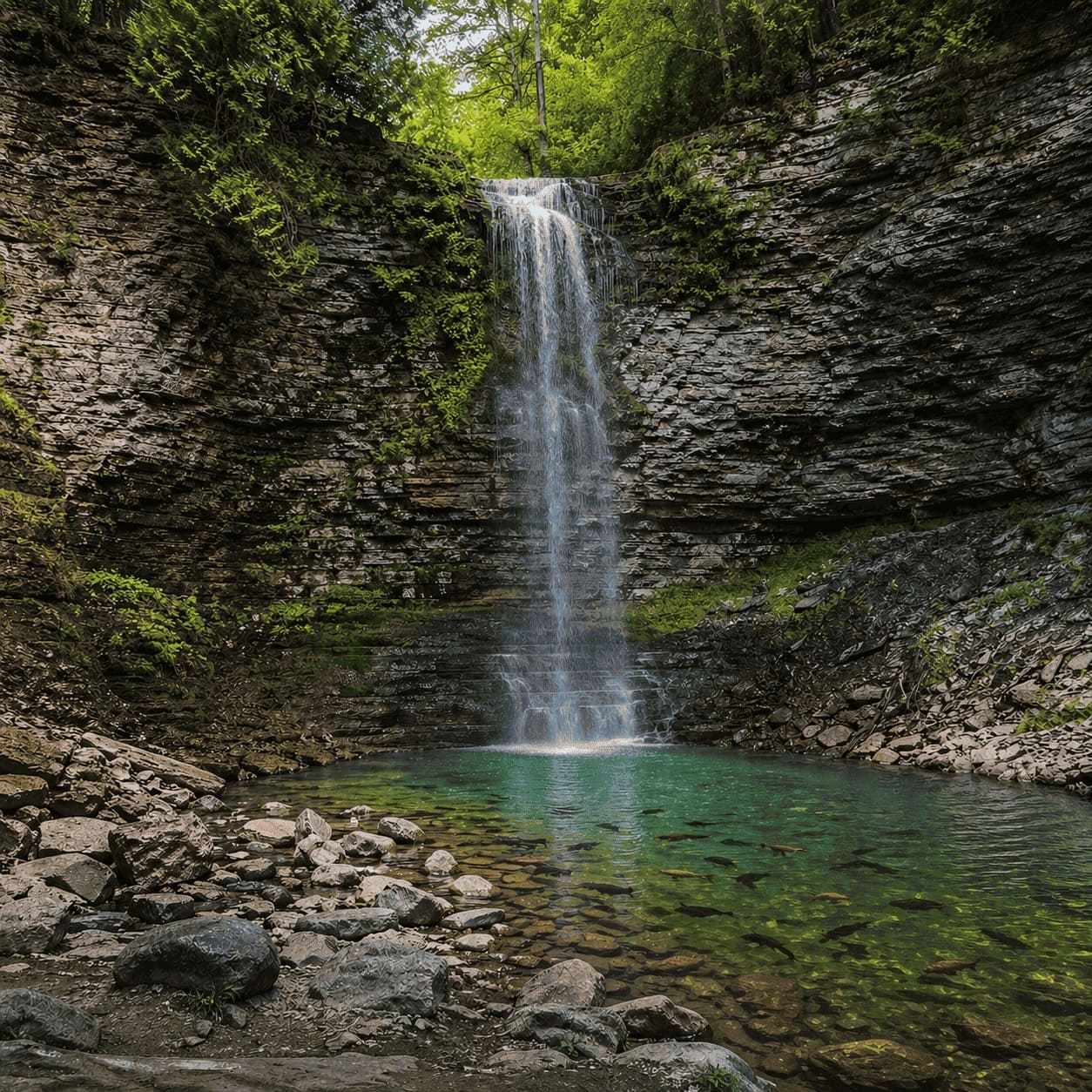
The Upper Falls is a commanding display of nature’s force. This classic cataract, or plunge waterfall, drops an impressive 27 meters (90 feet) from a wide, rocky crest of dolomite limestone into the deep gorge below. During the spring melt or after a heavy rainfall, Twenty Mile Creek swells, and the waterfall becomes a thundering curtain of white water. The sheer volume of water making its powerful descent is a testament to the grand geological story of the Niagara Escarpment—a story of ancient seas, glacial retreat, and the enduring power of erosion.
The Picturesque Lower Falls: A Cascading Beauty
Downstream from its larger sibling, the Lower Falls offers a different but equally enchanting geological character. This is a classic cascade waterfall, standing at a modest but beautiful 11 meters (36 feet). Here, the water tumbles and dances over a series of stepped rock ledges made of softer shale and sandstone, fanning out into a delicate curtain of water. Surrounded by the high cliffs of the gorge, the Lower Falls perfectly illustrates how water acts as both a powerful sculptor and a delicate artist over thousands of years.
The Twenty Mile Creek Gorge
Neither waterfall could exist without the unique geology of the Niagara Escarpment. The gorge is a masterclass in geology, its high cliffs revealing layers of rock that tell a story hundreds of millions of years old. As the creek encounters the hard, resistant caprock of the escarpment, it exploits cracks and weaknesses, eroding the softer layers beneath. This undercutting process created the steep, dramatic gorge. This secluded valley forms a unique microclimate that allows rare ferns, mosses, and a rich diversity of plant life to thrive.
The Carolinian Forest Ecosystem
The geographic footprint of Ball’s Falls lies within the heart of a rare and precious Carolinian forest. This unique ecosystem, also known as the Eastern Deciduous Forest, reaches its northern limit in Southern Ontario. It is characterized by remarkable biodiversity. The canopy is dominated by hardwood trees, including majestic Sugar Maples, American Beeches, Black Walnuts, and various species of Oak and Hickory. The forest floor is a critical habitat for a wide range of wildlife, serving as a sanctuary for migratory birds that use the Niagara Escarpment as a flight path.
Step Back in Time: The Historical Ghost Town of Glen Elgin
To research the history of this location is to take a tangible step into 19th-century Ontario. The physical area around the waterfalls is the site of the original hamlet of Glen Elgin, a community that once thrived on the hydropower of Twenty Mile Creek. The remnants and surviving historical structures stand as a silent testament to the resilience and ambition of early settlers.
John and George Ball: Pioneers on the Escarpment
The history of this location is inextricably linked to John and George Ball, two brothers who arrived in the area in the early 19th century. They were men of vision who saw opportunity in the raw, untamed power of the creek. Around 1807, the Ball brothers built their first sawmill, and by 1809, an impressive grist mill was complete. These mills were the catalyst for settlement, transforming the wild valley into a destination of industry.
The Rise and Fall of an Industrial Hamlet
For half a century, the community known as Glen Elgin flourished. A blacksmith, a cooper, a tailor, and a weaver all set up shop, creating a vibrant, self-sufficient village around the mills. However, the forces of progress eventually led to the hamlet’s decline. In the mid-1850s, the Great Western Railway was constructed, bypassing the valley in favor of a flatter path several miles north. Industry and settlement were drawn to the railway lines, leaving the hamlet of Glen Elgin increasingly isolated. By the turn of the 20th century, the community had dwindled into a ghost town, leaving behind a quiet, perfectly preserved relic of the pioneer era.
FAQ
What is Ball's Falls?
Where is this geographic area located?
Are there actual 'balls' in the waterfalls?
How many waterfalls are there?
What is Twenty Mile Creek?
What was the original name of the settlement here?
Who were John and George Ball?
Why did the hamlet of Glen Elgin become a ghost town?
What kind of ecosystem surrounds the waterfalls?
Related posts:
 Ball’s Falls Thanksgiving Festival Ecology of Ball’s Falls: Carolinian Forest & Twenty Mile Creek Guide Nature & History of Ball’s Falls | Enthusiast Guide Glen elgin room Balls Falls Is Ball’s Falls on the Niagara Escarpment? | Geological Guide Can hikers swim in Twenty Mile Creek? History of Ball’s Falls: From Loyalist Settlement to Glen Elgin Ghost Town How old are the rock layers exposed in the gorge? Ball’s Falls, Ontario: History, Waterfalls & Geography Guide Geography & Geology of Ball’s Falls: Niagara Escarpment Strata